

Solidarity with Mayotte: Supporting Reconstruction
A year and a half after Cyclone Chido struck on 14 December 2024, the archipelago of Mayotte remains deeply marked by the disaster. Fondation de France continues its efforts to support affected populations, whose needs remain immense. Supporting reconstruction is one of the central pillars of its work, in a territory where precarious housing, which accounts for nearly 40% of the archipelago's homes, was destroyed or severely damaged. The fundraising appeal launched after the cyclone raised €44.4 million. As of mid-May 2026, nearly €25 million has already been allocated to support 311 initiatives across Mayotte, including €7.2 million dedicated specifically to reconstruction.
Fondation de France has gradually structured its response to support the archipelago's reconstruction while navigating complex challenges: land tenure issues, uncertain property ownership, limited access to standard government assistance programmes, and the need to prioritise the most vulnerable housing. During the first year after the cyclone, the priority was to conduct on-the-ground assessments and structural diagnostics, while building cooperation among the many stakeholders involved, including non-profit organisations, public authorities, insurers, and local actors. The goal was to prepare for a sustainable reconstruction effort suited to the realities of the territory. Today, reconstruction projects are under way, working directly with residents. To date, 21 initiatives have been supported to rehabilitate private housing for the most vulnerable residents across the archipelago.
Planning for the Long Term
Given the scale of the destruction, the number of organisations involved, and the many technical constraints, Fondation de France is taking a long-term approach. Before launching large-scale reconstruction projects, it chose to support several initiatives aimed at better understanding the territory's vulnerabilities and the causes of the damage observed.
The non-profit Likoli Dago, for example, led a study bringing together experts in urban planning, construction, agriculture, natural areas, and land use to analyse the cyclone's impacts and draw lessons for the future. This work resulted, in late February 2025, in the publication of a report titled Regards croisés sur les impacts du cyclone Chido à Mayotte: analyses et propositions (Cross-Perspectives on the Impacts of Cyclone Chido in Mayotte: Analysis and Recommendations). The organisation also runs workshops to help residents and local tradespeople repair and reinforce buildings, including training in cyclone-resistant construction techniques and tool lending. Ongoing support for trained tradespeople is also planned to ensure these best practices are properly applied on site. "Following up with trained tradespeople is an extension of the training itself. It's essential for making sure cyclone-resistant techniques are properly applied on site, and for helping tradespeople work through any difficulties they encounter," explains Sylvia Frey, co-founder of the organisation.
A central partner in reconstruction efforts, Mayotte's CAUE (Council for Architecture, Urban Planning and the Environment) expanded its teams of architects and legal experts to carry out field assessments, advise residents, and support local governments. The organisation conducted structural assessments of nearly 200 public buildings across eight communities in southern Mayotte, organised training sessions in cyclone-resistant construction, and developed a guidance document for residents on post-Chido reconstruction, distributed across the territory. It also hosts regular exchange sessions between non-profits, experts, and public officials to share best practices. "After the cyclone, we carried out assessments across the entire island, which allowed us to build a database of the main construction defects we observed. We then developed our guide to provide practical solutions to these issues," says Maud Andrianarinosy, an architect with Mayotte's CAUE.
Rebuilding With Residents
In a territory where precarious housing is widespread, involving residents directly in reconstruction is essential. That's why Fondation de France supports initiatives that strengthen local skills and help residents take ownership of solutions for securing and rehabilitating their homes.
The non-profit Actes et Cités works in the Mahabourini neighbourhood of Kaweni, an area of precarious tin-roofed homes built on a hillside. The organisation secures housing by stabilising weakened structures and improving roof waterproofing. At the same time, public meetings and hands-on workshops raise residents' awareness of natural hazards and pass on construction skills. Young people from the neighbourhood are also involved in the building work and supported in developing skills that improve their job prospects. A best-practices guide is currently being developed to share these securing methods more broadly.
In M'tsamboro, in northern Mayotte, the non-profit Architectes de l'urgence (Emergency Architects) has set up a supported self-rehabilitation programme. Through this technical and hands-on support from professionals, residents are able to repair their own homes. Around forty households, all in situations of significant vulnerability, will have their homes rebuilt with help from young people in job-training programmes.
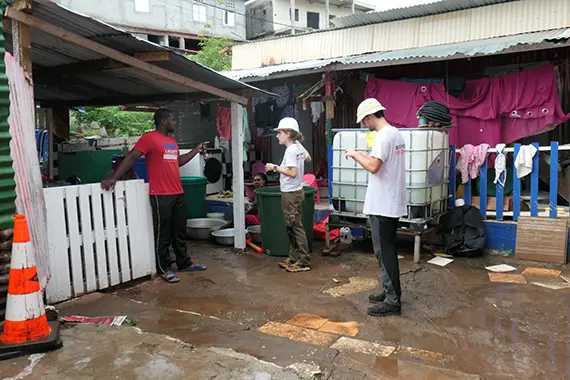
In Mamoudzou and M'Tsangamouji, the organisations Lieux Infinis, Le Pas de Côté, and Les Compagnons Bâtisseurs joined forces to rebuild four farés, traditional communal gathering spaces. These participatory building projects bring together residents, young people in training programmes, and vocational students, working alongside local authorities, to support reconstruction while raising awareness of cyclone- and earthquake-resistant building practices.
In partnership with the French state, the departmental council, and Fondation de France, Soliha is supporting the rehabilitation of around 100 private homes for families in situations of severe hardship. Separately, in Majicavo, 17 families have had their homes rehabilitated or have been rehoused with support from Fondation de France. This support also includes a year of administrative and social follow-up. "Our home in Majicavo was completely destroyed by the cyclone. Thanks to Soliha, my husband, our three children, and I were rehoused somewhere safe, and I can look toward the future with more peace of mind," says Anissa Hamed.
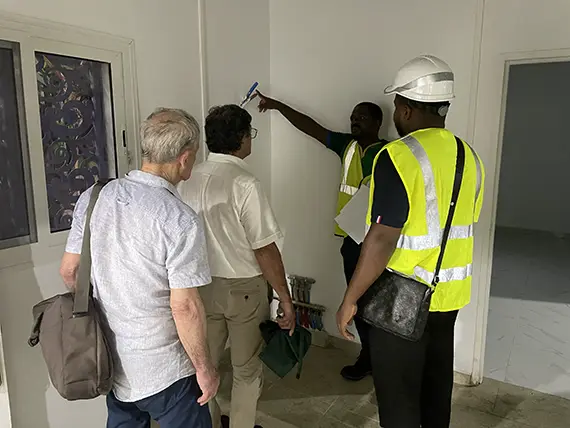
Separately, Les Compagnons Bâtisseurs (Builder Companions) provides on-the-ground support to the most vulnerable households. The organisation oversees roof and framing repair projects in the community of Ouangani, as well as participatory, supported self-rehabilitation projects carried out through a mobile "Bricobus" (a travelling tool and workshop van). The organisation also offers home-improvement guidance to around 100 families, runs community awareness sessions on natural hazards, and provides tools and technical support for small repairs.
Prioritising Eco-Friendly Construction
Working alongside a network of public and private partners, Fondation de France supports several initiatives that aim to ground reconstruction in the use of local resources and more environmentally friendly methods.
The non-profit Arterre is building a local supply chain based on excavated earth and plant fibres to produce compressed earth bricks. This approach makes it possible to rebuild using materials already available on the island, while reducing the carbon footprint and helping boost the local economy.
In a similar spirit, Kaja Koana operates a mobile brick-making unit that produces building materials directly on reconstruction sites. It trains and employs young apprentices, who take part in both production and on-site work, helping them build professional skills. The goal is twofold: to create local jobs and to strengthen skills in sustainable building techniques.
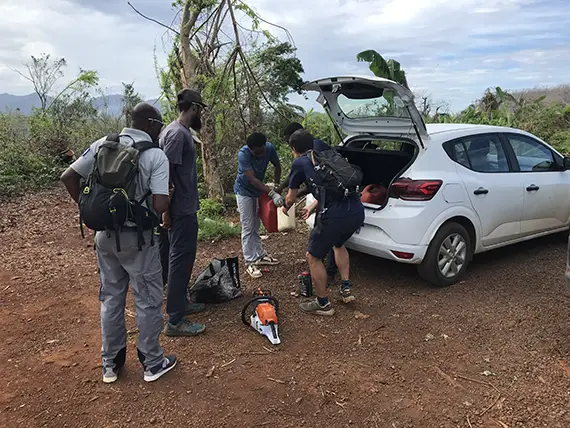
Lieux Infinis has deployed a mobile sawmill to make use of trees brought down by the cyclone. After acquiring the equipment, the organisation assessed available resources and trained local loggers, turning storm debris into useful building materials.
Environmental considerations also extend to protecting biodiversity, which was severely affected by the cyclone. Fondation de France supports, for example, the non-profit GEPOMAY, which works to integrate ecological concerns into Mayotte's reconstruction. The organisation studies the cyclone's impact on biodiversity, including mangroves and local species, oversees clean-up operations to minimise harm to native species and control invasive ones, and raises awareness among residents and farmers about post-disaster best practices and the essential role of natural ecosystems. GEPOMAY has also produced a guide for public officials involved in reconstruction, to help integrate biodiversity considerations into land-use planning on a lasting basis.
À LIRE AUSSI