

The “Nouveaux commanditaires” : Art for the People
Launched in the early 1990s by Fondation de France as part of the “Création et société” programme, the initiative known as the “Nouveaux commanditaires” revolutionised the cultural and artistic practices of the time by enabling any member of the public to commission a work from an artist to address, through art, an issue that directly concerns them and thereby strengthen social cohesion.
“The artist François Hers, who launched the initiative, began with the idea that, in a democracy, citizens should be able to commission a contemporary artist to address a social issue or a planning matter ”, explains Catia Riccaboni, Head of Programmes and Hosted Foundations for Culture and Society at Fondation de France. “In France, the focus was on the cultural offer offered by the State to its citizens. The “Nouveaux commanditaires” reversed this pattern by starting with the demands of the citizens themselves”, she adds.
A model yet to be devised
Whilst this approach was groundbreaking in the art world, it also led Fondation de France to devise a new model for its work. In the 1980s, this approach was based primarily on launching calls for proposals to support existing initiatives that addressed challenges identified at an earlier stage. Through the Nouveaux commanditaires initiative, Fondation de France has proposed a new model for action based on citizens themselves taking the initiative to address the challenges they face.
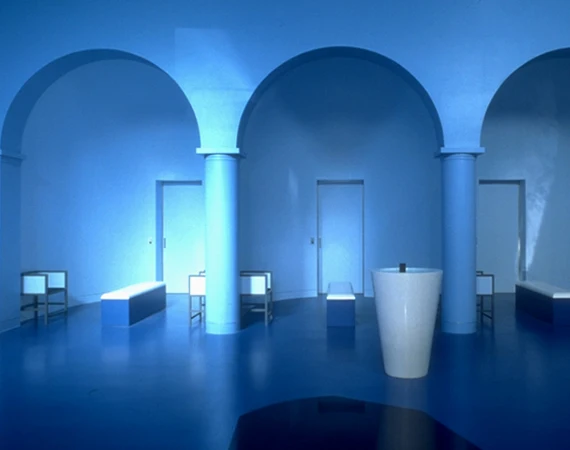
The protocol, which remains in force, was devised by François Hers, a former cultural adviser at Fondation de France, after Bernard Latarjet, Director-General of Fondation de France from 1989 to 1991, asked him to consider a model for cultural policy that would move away from traditional grant-giving. The protocol is based on a clear division of responsibilities between three parties: the commanditaires, the mediators – who are accredited by Fondation de France – and the artists. They are supported by public and private sector partners.
“The commanditaire is responsible for the commission. It must be able to demonstrate to a wider community the need to use art to address a specific situation or need. For its part, the mediator organises the collaboration, recommends the appropriate artist and medium, oversees the production and reports to all stakeholders. Finally, the artist designs the work in response to the expressed needs”, explains Catia Riccaboni.
To ensure the project gets off the ground and becomes a reality, Fondation de France provides support to the organisations in which the mediators work. It also sets up a production support fund to finance the research costs incurred by the artist when presenting a project to commanditaires, as well as part of the costs of producing the commissioned works. Fondation de France has thus provided funding of between 1.5 and 1.8 million euros a year to the Nouveaux commanditaires, enabling nearly 500 projects to be launched since the initiative began.
Mediators at the heart of the programme
Selected for their in-depth knowledge of contemporary art as well as their ability to listen, the mediators play a crucial role; they are the true driving force behind the programme. It is they who identify situations where citizens have a “problem” for which artistic creation may be an appropriate response. Needs can range from recognising marginalised groups to transforming a place where people live or work, including the desire to rebuild social ties, to promote a local area and its history, or to support the ecological transition. The mediators then help the commissioning citizens to set out the issue that concerns them in a brief, and then put them in touch with artists who are able to address it. They provide support at every stage: the artistic concept, securing co-funding from public and private partners (the State, local authorities, European funds, businesses, organisations and foundations), production, right through to the installation of the artwork. Their role is all the more important given that a “Nouveaux commanditaires” project lasts, on average, three to four years.
To get the project off the ground, it was important to find well-known figures from the world of contemporary art who would agree to take on the role of mediator. In particular, François Hers met Xavier Douroux, who was then director of the Le Consortium art centre in Dijon. “Eager to move beyond the exhibition space to become an active player in the region, Xavier Douroux became one of the emblematic mediators of the Nouveaux commanditaires and one of the movement’s historic spokespeople,” recalls Catia Riccaboni.
At the École du Magasin, which trains professionals in curatorial practices in Grenoble, François Hers then asked students to design prototypes for commissions. Impressed by the approach, several people have approached Fondation de France to become accredited mediators. Gradually, a structured network began to take shape across the country.
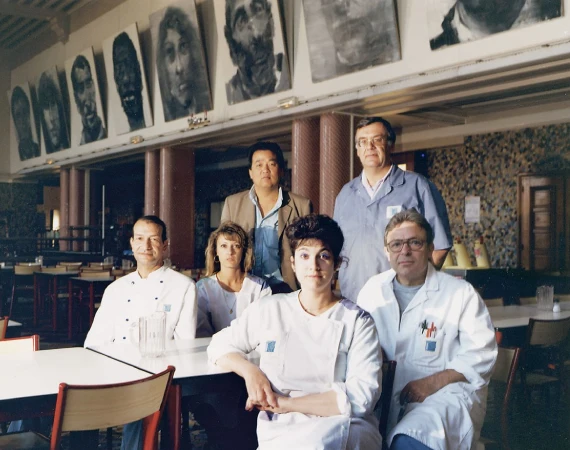
Once the first mediators had been recruited, the projects were able to get underway. “Xavier Douroux went to meet the staff of the Le Maret university canteen in Dijon. They thought they had ‘nothing to ask of art’”, recalls Catia Riccaboni. One thing did, however, emerge from the discussion: every day, thousands of meals are served without anyone knowing who prepares them. Accompanied by their mediator, the group of commanditaires came up with the idea of commissioning the artist Yan Pei-Ming. The painter, who had been a student at the CROUS and had already met some of the staff, then suggested to them that he create giant portraits of ten of them, to be displayed in the canteen itself. This first commission, carried out as early as 1992, demonstrated that art could respond to a specific situation and transform the way a community perceives itself and is perceived by others.
Another flagship project: the Blé en Herbe school in Trébédan, in the Côtes-d’Armor, which opened in September 2015. As part of the necessary refurbishment of the municipal school’s buildings, the teachers wanted to make the school a focal point of this village of 400 inhabitants. Together with parents, the mayor of the town and a former pupil, they formed a group of “Nouveaux commanditaires” to highlight the school’s social and cultural role and to bring a touch of modernity to rural areas.
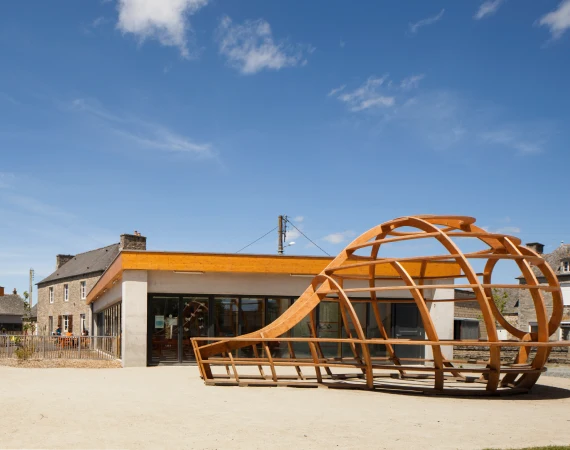
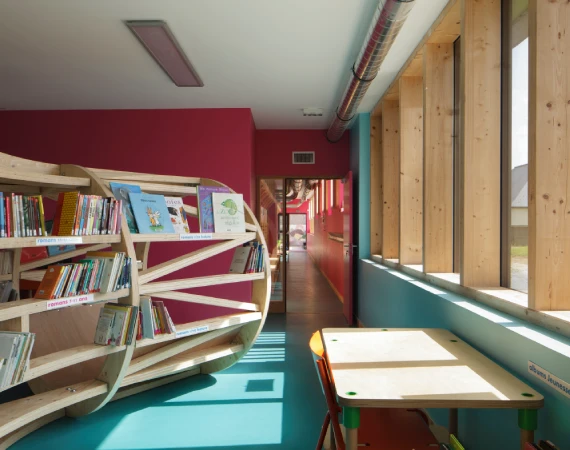
For the project, which was coordinated by Anastassia Makridou-Bretonneau and Eric Foucault, the Nouveaux commanditaires group commissioned the designer Matali Crasset, who devised a modular and adaptable architectural design, conceived as a learning space open to the village. More than just a renovation, the school has once again become a focal point and a symbol of what the Nouveaux commanditaires’ initiative can achieve: a community that tackles a challenge through art, and a work of art that meets a collective need.
A pioneering approach that is being adopted and taught abroad
In the early 2000s, the initiative attracted interest from several European countries. With the support of Fondation de France, and under the leadership of the King Baudouin Foundation and the Adriano Olivetti Foundation, Belgium and Italy have adapted the model to their own cultural contexts. The protocol was subsequently adopted in Germany, Spain, Switzerland, Great Britain, Sweden, Finland and Norway.
Another key milestone: the inclusion of the Nouveaux commanditaires within the academic sphere. “There was no precedent for the role of mediator. We had to invent it”, recalls Mari Linnman, an art mediator since 1998 and co-director of the Société des Nouveaux commanditaires. To pass on this unique methodology and train new professionals in the production of artworks commissioned by the public, Amanda Crabtree, an arts mediator, has developed a training course at the University of Lille, in collaboration with Fondation de France and the Centre for the Study of Contemporary Arts, entitled “Creating art as we create society: mediation and production in contemporary arts”. “This degree has helped to recognise the Nouveaux commanditaires not only as an artistic initiative, but also as a genuine model of democratic action, which is now taught,” emphasises Catia Riccaboni.
Practices and themes that are constantly evolving
Over the years, artistic forms have become more diverse. “For a long time, the projects were mainly in the field of the visual arts”, observes Catia Riccaboni. “After about fifteen years, there was a desire to open up to other disciplines, particularly the performing arts.” At the MC93 Seine-Saint-Denis in Bobigny, for example, a group of Nouveaux commanditaires – made up notably of theatregoers and local residents – posed the question: “How can we act together?”. To answer this, the Travaux Publics group brought together artists and social workers in the show “Le Social brû(il)le” to bring to life situations inspired by the field. Performed five times in February 2023 at the Théâtre National de Bobigny, the show – which blends stories, discussions and experiences gathered during workshops with social workers from Seine-Saint-Denis – then went on tour.
The topics covered have also evolved. “At first, many commissions aimed to mark a territory, to make visible groups or situations that were little regarded,” explains Mari Linnman. “Today, environmental issues are at the heart of almost all requests. There is not a single commission, whether direct or indirect, that does not challenge our relationship with the environment.”
A valuable experience for artists
Whilst the Nouveaux commanditaires are transforming regions, they are also changing the way artists work. Since the initiative began, the Nouveaux commanditaires have commissioned recognised artists from the contemporary art scene: from the painters Ettore Spalletti and Françoise Pétrovitch to the visual artist John M. Armleder and the sculptor Daniel Buren, for whom these projects have provided a different way of getting involved.
“For artists, it is a way of moving away from the art market and entering into a direct dialogue with society”, emphasises Catia Riccaboni. “These are not separate works; they are an integral part of the artist’s history.” This relationship between artists and members of the public, based on listening and a long-term perspective, is one of the programme’s greatest strengths. “There is a dialogue with the commissioners, centred on their needs and their stories, which fuels the creative process. It is this interaction that makes the Nouveaux commanditaires so unique”, adds Mari Linnman.
Passing the baton
Like any experiment, the initiative has reached a turning point. In 2020, Fondation de France announced its gradual withdrawal from the Nouveaux commanditaires scheme. “There was no question of pulling out overnight. We supported the mediators in setting up a national organisation: La Société des Nouveaux commanditaires”, explains Catia Riccaboni. Together with the Ministry of Culture, Fondation de France has therefore signed a three-year tripartite agreement with the newly established association, covering the period from 2022 to 2024. Although the Foundation’s most recent support for the Nouveaux commanditaires’ initiative took place in 2025, new community commissions are currently underway. The Ministry of Culture has in fact signed a multi-year agreement with the Société des Nouveaux commanditaires, which has also received structural support from the Daniel et Nina Carasso Fondation.
“The support provided by Fondation de France over the past thirty years has enabled us to build up a solid core of mediators, which in turn has allowed the initiative to continue for so long. This support has given them the time to become experts and to now facilitate the transfer of skills that is essential to the long-term sustainability of the initiative”, explains Chantal de Singly, former chair of the Société des Nouveaux commanditaires.
“This initiative is very much in keeping with Fondation de France’s ethos”, sums up Catia Riccaboni. “It is based on people’s capacity to take action and the belief that, whilst we may hold different opinions, we must never stop cooperating and engaging in dialogue. What binds us together? At what point can I agree to let something go because the outcome affects me, and affects us all?”
By bringing together citizens, artists, mediators and partners – some of whom hold very different views – around the same table, the Nouveaux commanditaires have made cooperation a driving force for creativity. “What stands out to me from all these projects, is the remarkable ability of people to work together,” she concludes.