

Turkey-Syria solidarity: on the ground with the Samandag Women’s Solidarity Association
More than three years after the powerful earthquakes that struck southern Turkey and northwestern Syria, the Fondation de France remains fully committed to providing aid to the affected populations. From 6 to 13 June, the Fondation de France’s Emergency Response Team travelled to Turkey to monitor the progress of ongoing initiatives, meet with local partners, and strengthen cooperation in the region. Among the organisations receiving support, the Samandag Women’s Solidarity Association (SWSA) assists the most vulnerable populations.
During this field mission, the Fondation de France team met with twelve organizations it supports, including three Syrian partners and nine Turkish ones. The needs of the population remain immense: thousands of people are still living in container cities, with no sustainable housing solution in sight. Children and women are among those most at risk, facing increased risks of violence, dropping out of school, and limited access to health care facilities.
In the province of Hatay, in southern Turkey, the Samandag Women’s Solidarity Association, for example, provides assistance to the most vulnerable communities. Since 2023, with support from the Fondation de France, it has opened a centre in Samandag dedicated to women, children, refugees, and people with disabilities, to promote solidarity and their independence. “In the wake of the earthquakes, Samandag had to not only rebuild its homes and infrastructure, but also restore a sense of security, rebuild bonds of solidarity, and give its people hope for the future. "Our centre plays a vital role in the reconstruction process," says Neşe Koku, an official with the association.
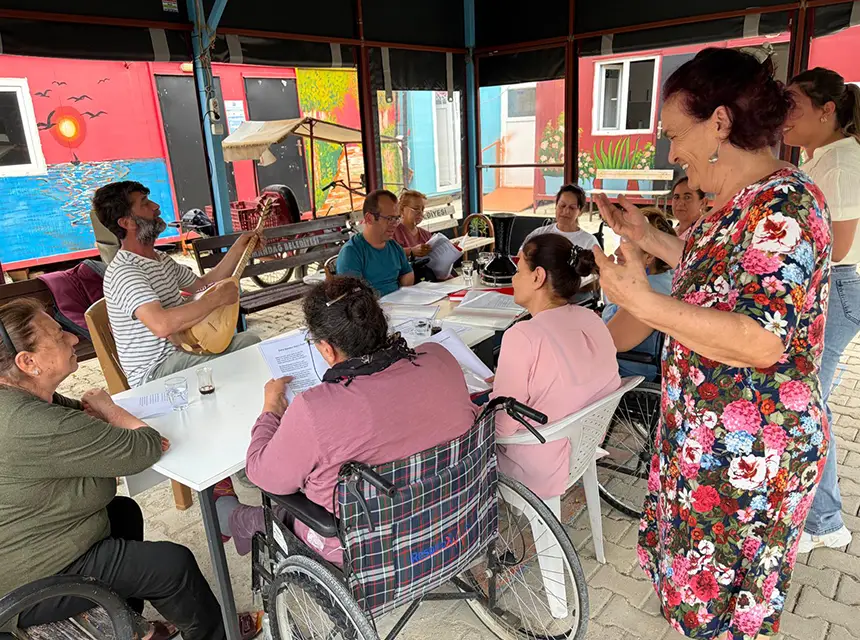 In Turkey, the Samandag centre—opened by the Samandag Women’s Solidarity Association with support from the Fondation de France—provides shelter to the most vulnerable people.
Organized around several converted shipping containers, the centre offers a wide range of services and activities: administrative and social assistance, psychosocial support, childcare, fun workshops, vocational training, literacy classes for refugees, education on sexual and reproductive health, and information sessions on rights. It also features essential living spaces: a kitchen, a garden, a children’s play area, a library, laundry facilities, and showers. “The centre is a safe and inclusive space that protects and strengthens the culture of living together.” Families find a supportive environment here where they can share their experiences, learn new skills, and, above all, feel less alone”, emphasizes Neşe Koku. Special attention is given to providing educational support for young people at risk of dropping out of school, with particular focus on girls, who are more vulnerable to dropping out and forced marriage.
The association also deploys a mobile team that works in the most isolated neighbourhoods to reach out to the most vulnerable populations. It also mapped out local health and social service agencies according to their areas of focus in order to best guide residents based on their needs. The centre’s staff were also directly affected by the earthquake: “Thanks to this centre, we have not only supported others in their recovery, but we have also, little by little, healed our own wounds, regained our strength, and rediscovered hope,” explains Neşe Koku.
The centre currently serves nearly 2,000 people and has established itself as a nationally recognised model, attracting the interest of government authorities, who are exploring the possibility of replicating the program in other affected areas. “The support provided by the Fondation de France goes beyond simply establishing the centre: above all, it ensures its long-term viability and sustains a place that supports thousands of women and children, strengthens local solidarity, and contributes to the rebuilding of an entire community,” concludes Neşe Koku.