France’s unwavering solidarity: giving in excess of €9 billion
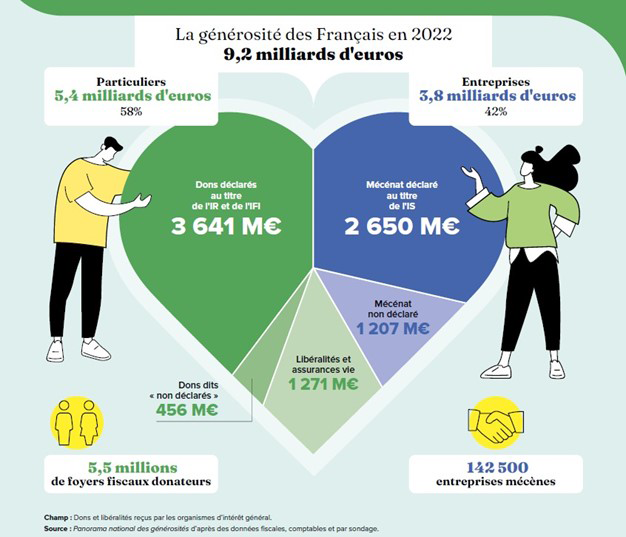
Against a national and international backdrop marked by crises, conflicts and uncertainty about the future, individuals and businesses remain resolutely generous and supportive. This is confirmed by the third edition of the National Giving Landscape: in 2022, French giving amounted to €9.2 billion, an increase of 8% compared to 2019.
The National Giving Landscape is the only study that, every three years, brings together data on individual giving and corporate philanthropy. Produced by France Générosités in collaboration with the Fondation de France’s Philanthropy & Society Observatory, this third edition offers an objective snapshot of giving in France. In 2022, 58% of gifts came from individuals, amounting to €5.4 billion, and 42% from corporate sponsors, amounting to €3.8 billion.
Philippe Pailliart, President of France Générosités, says: “Individual and corporate donors have never been so actively involved in collective action. Their generosity enables public interest associations and foundations to really respond to the expectations and needs of our fellow citizens. Without it, nothing would be possible: it is proving more than ever to be a cornerstone of our social model.”
French donors resilient in the face of crises
Despite inflation and social and economic difficulties, French donors have shown incredible resilience. In 2022, their giving amounted to €5.4 billion, of which €3.6 billion came from donations declared by 5.5 million tax households in their income tax (IR) and/or wealth tax (IFI) returns. Since 2006, this figure has multiplied by 2.3, with an average annual growth rate of 6%.
As in the previous edition of the Giving Landscape, we observe a trend in giving driven by the wealthiest and increasingly older tax households. In 2022, 1 in 3 donors belonged to the top 10% of tax households, many of whom also make donations under the IFI. Tax households where the primary filer is over 60 years old account for 53% of donor tax households.
This third edition of the National Giving Landscape confirms the growth in charitable gifts (bequests and donations) and life insurance policies, which increased by 13% between 2019 and 2022 to reach €1.2 billion in funds raised. Life insurance policies are particularly dynamic, now accounting for 30% of the total. Demographic and wealth trends in France, as well as globally, suggest that this growth in charitable giving is likely to continue in the coming years. While 9% of those over 50 say they are willing to make a bequest to a non-profit organisation, only 2% actually do so.
“More and more French people are showing their solidarity, despite a context marked by multiple crises,” notes Axelle Davezac, Executive Director of the Fondation de France. “And this generosity is evolving; going beyond traditional fundraising methods, it is taking on diverse and creative forms. ‘On-the-go’ giving is on the rise, for example, with micro-donations having doubled since 2019, or online charity events reaching new donors, such as ZEVENT, which raised €10 million in a single weekend.”
The rise of corporate philanthropy by micro-enterprises and SMEs at the heart of local communities
Corporate philanthropy reached €3.8 billion in 2022, of which €2.65 billion was claimed as a corporate tax deduction. Since 2010, this amount has multiplied by 2.7, with an average annual growth rate of 9%.
The number of corporate sponsors multiplied by 5.2 between 2010 and 2022. This growth was driven by micro-enterprises and SMEs, which accounted for 98.7% of corporate sponsors in 2022. Micro-enterprises and SMEs are also driving the increase in the amount of corporate philanthropy dedicated to the public interest, as 34% of reported corporate philanthropy came from micro-enterprises and SMEs in 2022, compared to 27% in 2019 (and 15% in 2010). This particularly active corporate philanthropy at local level helps create regional momentum.
Large companies remain the leading contributors in terms of amount, accounting for 42% of reported amounts in 2022 (compared to 63% in 2010). Particularly impacted by the global context during the COVID-19 crisis (a 15% decline in their philanthropy between 2019 and 2021), they returned to growth in 2022, with a 10% increase between 2021 and 2022.
Giving bolstered by emergency situations
The third edition of the National Giving Landscape reveals a positive upturn in the number of donor households between 2019 and 2022. There were 5.5 million such households in 2022. This represents an 11.7% increase compared to 2019, whereas their numbers had plummeted between 2015 and 2019, falling from 5.7 million to 4.9 million.
Emergency situations attract new donors who are especially, or even exclusively, responsive to such contexts and who are characterised by often one-off donations.
For example, donations and bequests to public bodies increased by 23% between 2021 and 2022, notably through government relief funds for exceptional emergencies, such as the Notre-Dame fire, the war in Ukraine and hurricanes in the Caribbean.
More broadly, donations to organisations supporting people in need grew by 61% between 2019 and 2022, accounting for one fifth of declared donations from individuals in 2022, following a surge in calls for widespread solidarity in response to rising poverty in France.
1 Transmission du patrimoine aux associations et fondations faisant appel à la générosité du public, l’ObSoCo pour France générosités, 2020.
3rd edition of the National Giving Landscape
This study is carried out by France Générosités in collaboration with the Fondation de France’s Philanthropy & Society Observatory.
The aim of the study is to assess the scale of philanthropy in France in the form of monetary donations, whether from individuals or businesses. It aims to report on trends in the various forms of giving towards organisations of general interest. It draws on three data sources: data from the tax returns of individuals and businesses provided by the Directorate-General of Public Finances of the Ministry of Finance and Public Accounts, and data from the organisations receiving donations, taken from their annual accounts and available in the Official Journal.